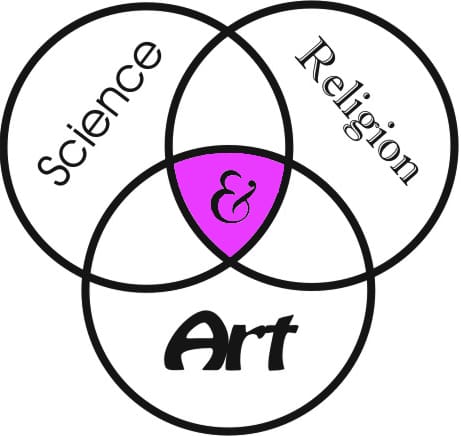
Science, religion, art intersection.

Octagod Theology

Religious symbols reaching for the sky.

Exploring a theology of the Big Bang

  A work in progress. The Octagod is part of a larger philosophy of art and science. In this menu you can explore how this philosophy and artwork relates to a symbol of The Big Bang, and The Octagod. My hope is to present a coherent philosophy of how Art can relate to both Science, and Religion. This website is of course a work in progress. So please excuse any things that have yet to be finished.

oct-1

As well as a faith statement the Octagod is fundamentally an exercise in the artistic interpretation of science.

Some quick thoughts that seem to flow into and out of this symbol.

Everyone has a God

If you define God as ultimate context then everyone has a God. This ultimate context could be family and community. In which case "God is Love". Life itself could be the context. In which case "God is the love of life". Nature could be the ultimate context. In which case "God is nature". Or it could be the Universe itself. And in this case what greater context could there be?

A God for Atheists 

God is good. God is healthy. God is good for our sense of community. God is something an atheist should want. I did. And that's why the Octagod emerged. The Octagod has its roots in science-art and an atheists envy of believers. The Octagod disavows super-naturalism. And instead focuses the mind on the material magic which is Universe. And the Multiverse from which it seems to have emerged.

What is Emergence that you should be mindful of it?

Emergence is natural becoming. Creation without a specific creator. A self-organizing Universe. You would say; "The world wasn't created, it emerged". But Emergence is a many splendid thing; Consciousness emerges from the brain. Quantum computing emerges from the cold. The present emerges from all that has gone before.  Everything is contingent. So in an ever changing world everything is unique. Emergence isn't super-natural. But it is surprising.

Feedback is central

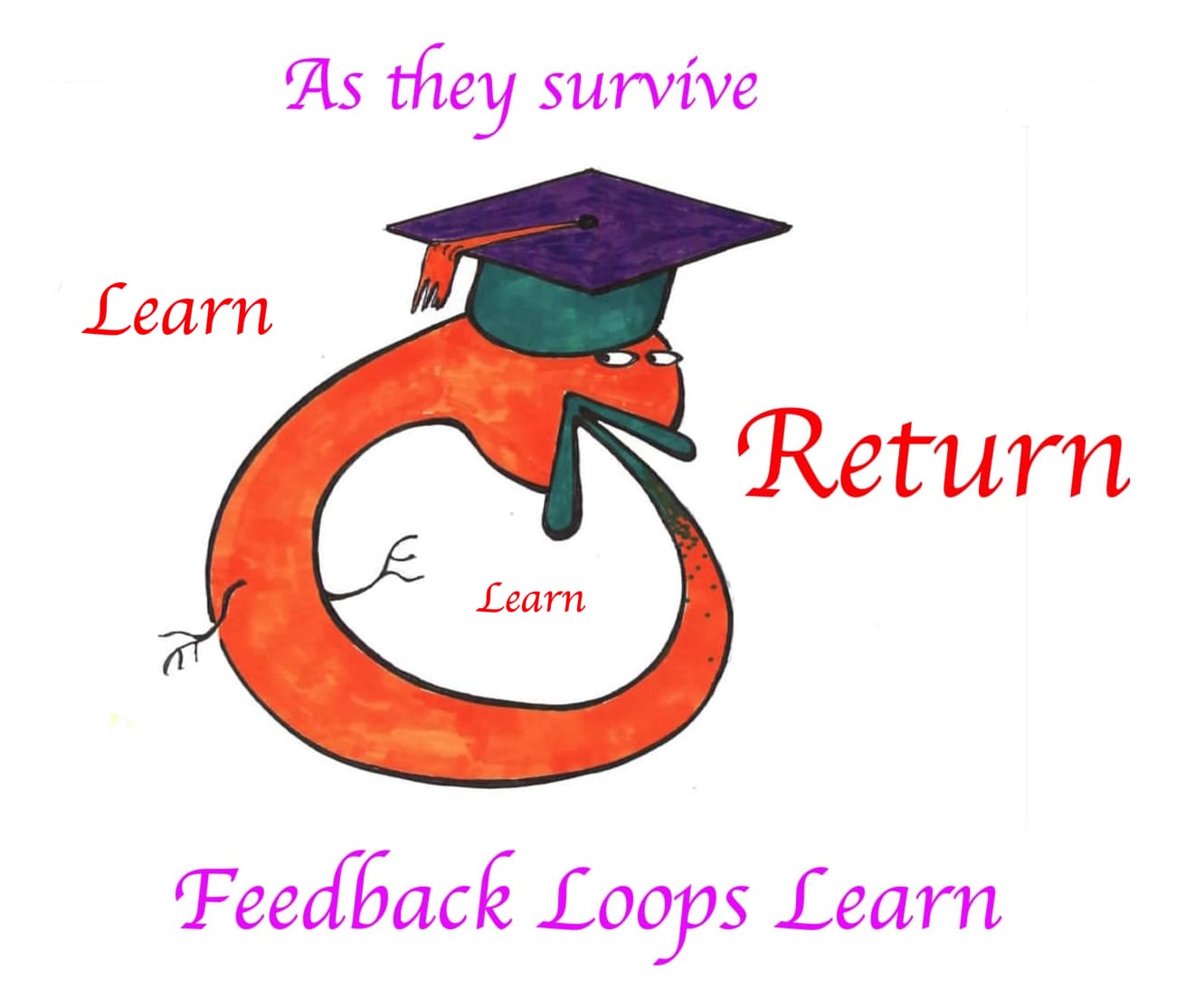
The Octagod is a thought symbol that connects Life to Non-Life. Life and Non-Life are very different. Everything that lives has found a way to survive and reproduce. Reproduction is a form of feedback. Non-Life is different. Everything in the world of Non-Life is dying, it's moving toward minimum energy and maximum entropy. Life lives on the death of the Universe. Life is like a purpose filled water wheel driven by the flow of time.

Feedback is life

The trial and error of life's evolution and the trial and error of human life are driven by the same process. The process of feedback. When you look at your hands and watch what you do, this is feedback There is a kind of enlightenment that comes with seeing yourself as a feedback loop. Feedback loops that interacts with a larger reality. Without feedback there would be no ego. Feedback is a kind of essence. An essence from which many different things emerge.

Feedback loops have bottlenecks

Life in general and your existence in particular emerges from feedback loops. For you the loop goes through your senses and body. It goes in through you senses. It goes out through your body. Goes into the world through you actions and back into your senses. The key part of the loop is your brain. Reproduction, through the generations, is an extended feedback loop. Babies come out, grow up and then try to reproduce. The bottle neck comes with mate selection, sex and family. And that whole thing is obviously the bottle neck that gets all the attention.

Feedback and morality

Larger loops generally have more moral standing than smaller loops. Simply compare addiction to long range planning. Or patience verses an angry outburst. Think of what it takes to raise a child, or create a political movement.

The psychology of a feedback loop 

In active living your feedback loop is continuous and generally unacknowledged. And this unconsciousness comes with implications. The inside and outside can not be fully separated. So when the outside goes in we can imagine concrete things in our minds.  And when the inside goes outside we get the opposite. We can imagine beings without bodies, ghosts and the remembered spirits of loved ones. We look for values in the non-living world. We can even imagine empty space as if it were living. As well as other things that extend the realm of being far outside the living body.

Sensation and God as being 

The raw material for sensation comes from the outside the body. But then that raw interaction is processed inside the brain and body. But to a large extent we do not feel the brain operating. There is little reason or survival value for us to witness ourselves as perceiving. The world simply seems to be out there. But it's not. Rather it draws its life from the life of the brain. And so everything, alive or not, seems to have this quality of being. So to some extent the all encompassing being of God is really just you.

God and the sky

God is frequently associated with the sky. Because as I've said God helps us define ultimate context. The earth exists "under" the sky. So the sky defines the context for everything below. Also all people live under the sky. So it's something we all have in common. Many say God is Love. Because love brings us together. Together under our one big common sky.

The Anthropomorphic imperative 

From mother earth to God the father seeing the world in human terms is a natural part of our psychology. In this system of thought there is a special place for this inclination. I call it " Narrative Science Cartooning". It is my opinion that blending science and religion, or cultural mythology if you will produces some unique outcomes. One of these may be a new form of cartooning.

We are the Universe seeing itself 

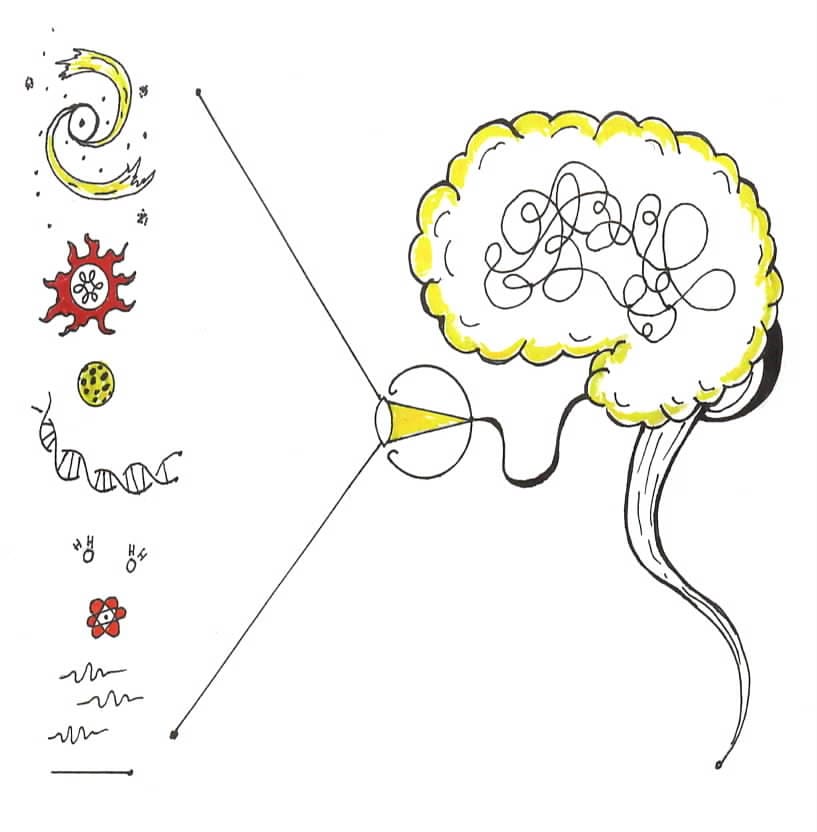
We emerged from the Big Bang. If you count that as your birth day you are billions of years old. But this true age isn't obviously represented in your personal social life. But it is represented in the physical matter of your body, the biology of your body and your emotions. Our bodies show close relationships to; gravity, to molecules, to light and electromagnetic radiation, to expansion and contraction, and to sound. Through eons of evolution we have come to reflect these and other characteristics of the Universe. And now, through our science and technology we have come to reflect even more.

Drawing personal power from deep-time

We come from the Universe. It belongs to us. And we belong to it. Being at home in the universe brings us comfort. But there's more. We as human beings are the descendants of creatures that have survived no less then five mass extinctions. So in your heritage you are the toughest of the toughest. That deep-time truth. That truth from evolution and its successes can give you confidence.

The Big Bang is everywhere

The Biog Bang didn't happen in a place.  Because the Big Bang was the author of space itself. If it had a "center" then the center is everywhere. The Big Bang isn't a distant thing. The Big Bang envelopes. The Big Bang is time and space itself. It's inescapable. It's in us, and surrounds us. In this sense the Big Bang feels very muck like the traditional notion of God.

Inside the Big Bang

Space and time seem to be emergent. So it's probably improper to think of something as "outside" or "before" the universe. And yet in our feelings and imaginings it's hard to shake the idea that somehow we are inside of a cosmic womb. The Multiverse is a pregnant mother. Or maybe a cosmic creator .

Interpreting the Multiverse

Life emerges from chemistry. Chemistry emerges from the fundamental particles. And the particles emerge from the Big Bang. We have life. But it could have all been different. Life emerges in this galaxy. And galaxies emerge from the Big Bang. But again it could have all been different. This universe made life. But other universes probably didn't. We live in the universe, the lucky-verse, that got it right. And if it wasn't right we wouldn't be here to know about it. This is downward causation. There can be many variations of the Big Bang. But very few work for life.

Miracles and downward causation

The black swan, the perfect storm, someone winning the lottery three times in a row. Given enough time and variation it seems that almost anything could happen. We live on miracle planet. But only because the universe is so varied and vast. Evolution proceeds because of variations in populations. Large numbers are the source of good (and bad) luck. Large numbers make the unlikely inevitable. This is the miracle of downward causation.

Interpreting cosmic inflation

In the very first moment of time the universe expanded from something in the quantum realm to something we would call normal size. The imprint of this expansion can be seen in the large scale distribution of galaxies which follow patterns laid down by quantum fluctuations. To me, inflation, this simultaneous display of large and small has a clear implication. For me, the artist, cosmic inflation wasn't the universe going from small to large. But rather, at that moment of of birth, the universe was both large and small. The symmetrical union of large and small. Artistically I explore this idea in my narrative science cartooning. But is it true?

Physics of a one sized universe?

Here are a few thoughts that might make you think the universe is still a single point. Or at least that the difference between large and small might be different than you think;

1. The bell theorem and the non-locality of quantum entanglement.

2. Quantum fields that are everywhere exactly the same.

3. A black hole singularity with so much mass in a paradoxically small space.

4. The quantum distribution of galaxies.

5. And in the world of society, the representation of a whole group by a single individual.

I can only say this as a practical matter, In the art that I do. This "narrative science cartooning" destroying the distinction between large and small is the only way forward. One can only wonder...

A bias to bigness

A philosophy of personal deep time puts you in touch with your evolutionary biases. Perhaps there is none larger than our bias toward the big. When we are born our parents are bigger then us. Predators are bigger then us. When we move in the world, the world is bigger than us. Big things take up more attention. The survival value of a bias toward the big is obvious. But how true is this bias? This philosophy explores a second world view in which everything is seen as being the same size. So in art I ask what emerges when you look at the world in this way?

The Octagod: size does not matter

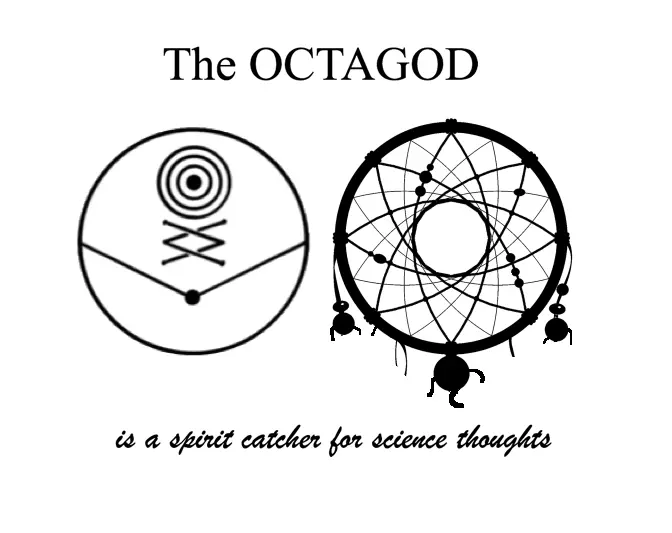
The Octagod is a symbol of the Big Bang and the ultimate fate of our universe. It speaks of many emergent steps. But the secret of its success is that it depicts them all, symbolically,  as approximately the same size. There is something deep about a size-less. universe. Perhaps something that goes beyond this artistic approach to the problem of science and art.

Science story telling

I work as an artist. you can see other projects I've done elsewhere on this site. My present work is with what I call "narrative science cartooning". In this cartoon art form every scientific thing (characters)  Galaxies, stars, living organs, DNA, molecules and atoms are all seen as being approximately the same size. This is not the common view of these things. But from a narrative artistic perspective this view offers a wide range of possibilities.

Science for art's sake

Technology uses science to create machines that extend human will. Science story telling, or narrative science cartooning, uses science to create stories that explore the relationship between our human psyche and the larger, non-living universe. Science makes stories. And science makes machines.

Quantum mechanics and gravity

Unifying large and small in art is one thing. Unifying them in physics is another. So I couldn't let the issue of gravity and Quantum mechanics go unmentioned. Here is the scientific question of our age. And it has to do exactly with this. The union of large and small.

Quantum mechanics gravity and the multiverse

In our universe it feels like it's gravity (space & time) verses everything else (the standard model of particles). Perhaps when thinking about the variations in the multiverse, gravity along with space and time might be a more "permanent" feature. While the details of the standard model, the particles settings, might be the more variable arm of the system.

Breaking symmetry

As the universe emerged form the Big Bang many symmetries were broken. The dispersion of the forces is one example. The selection of matter over anti-matter is another. In the symbolism of the Octagod this symmetry breaking is expressed in the greater and less than sign.

The loving arms of size

Perhaps the worst thing about astronomy is that it makes you feel small. But I don't think this feeling is entirely justified. In truth, I would say, we're somewhere in the middle. Somewhere between the size of a quark and the size of a galaxy. Somewhere between the size of an atom and the size of a solar system. For the most part were somewhere in between. We smell molecules with our nose and feel gravity with our feet. What other size could we be? You could say we're small but we're old. You could also say we're small but most of the complexity comes from things that are smaller. I say when thinking about the universe there are plenty of good reasons not to feel small.

Life - DNA the brain and the book

Three kinds memory produces three kinds of being; From DNA the ecology biological life. From the brain the ecology of self. And from the book the ecology of culture. We are made of, and live in all three.

Religion as primitive science

Both science and religion look out onto the world and try to give us a sense of context and orientation. Science does it with the aid measurement and mathematics. Religion does it with philosophy, introspection, history and mythology. Science and religion are in spirit very similar. But science has a larger vision of the universe.

The Octagod and the gospel of science

Established religions have holy books and long traditions. The Octagod, as a religiously inclined bit of science-art, can only refer you to science itself. And a spirituality that emerges from an appreciation of deep-time.

The Octagod; Judaism and Christianity

Artistically and religiously the Octagod emerges from the twin traditions of Judaism and Christianity. From Judaism it takes the tradition of questioning the nature of God. And from Christianity it takes the tradition of putting life and death into a strong central symbol.

The Octagod and America

The Octagod hails from Philadelphia. The first city in the keystone state. And coming from the keystone state seems particularly appropriate for a symbol that so obviously points, in many ways to dualism. And dualism I think is very much a part of American culture; From the two coasts. To the two borders. To country verses city. And of course our two party political system. The Octagod also tries to bring together faith and atheism. And my hope is that this thought is in some small way a help to our American experiment.

Thank You for your attention

The Octagod is a complex never ending source of inspiration. The more you look at it the more it says. I hope this does some good.