Interpreting cosmic inflation
In the very first moment of time the universe expanded from something in the quantum realm to something we would call normal size. The imprint of this expansion can be seen in the large scale distribution of galaxies which follow patterns laid down by quantum fluctuations. To me, inflation, this simultaneous display of large and small has a clear implication. For me, the artist, cosmic inflation wasn't the universe going from small to large. But rather, at that moment of of birth, the universe was both large and small. The symmetrical union of large and small. Artistically I explore this idea in my narrative science cartooning. But is it true?
The beginning of it all, the beginning of time. The conditions for our existence and the source of energy.
Physics of a one sized universe?
Here are a few thoughts that might make you think the universe is still a single point. Or at least that the difference between large and small might be different than you think;
1. The bell theorem and the non-locality of quantum entanglement.
2. Quantum fields that are everywhere exactly the same.
3. A black hole singularity with so much mass in a paradoxically small space.
4. The quantum distribution of galaxies.
5. And in the world of society, the representation of a whole group by a single individual.
I can only say this as a practical matter, In the art that I do. This "narrative science cartooning" destroying the distinction between large and small is the only way forward. One can only wonder...
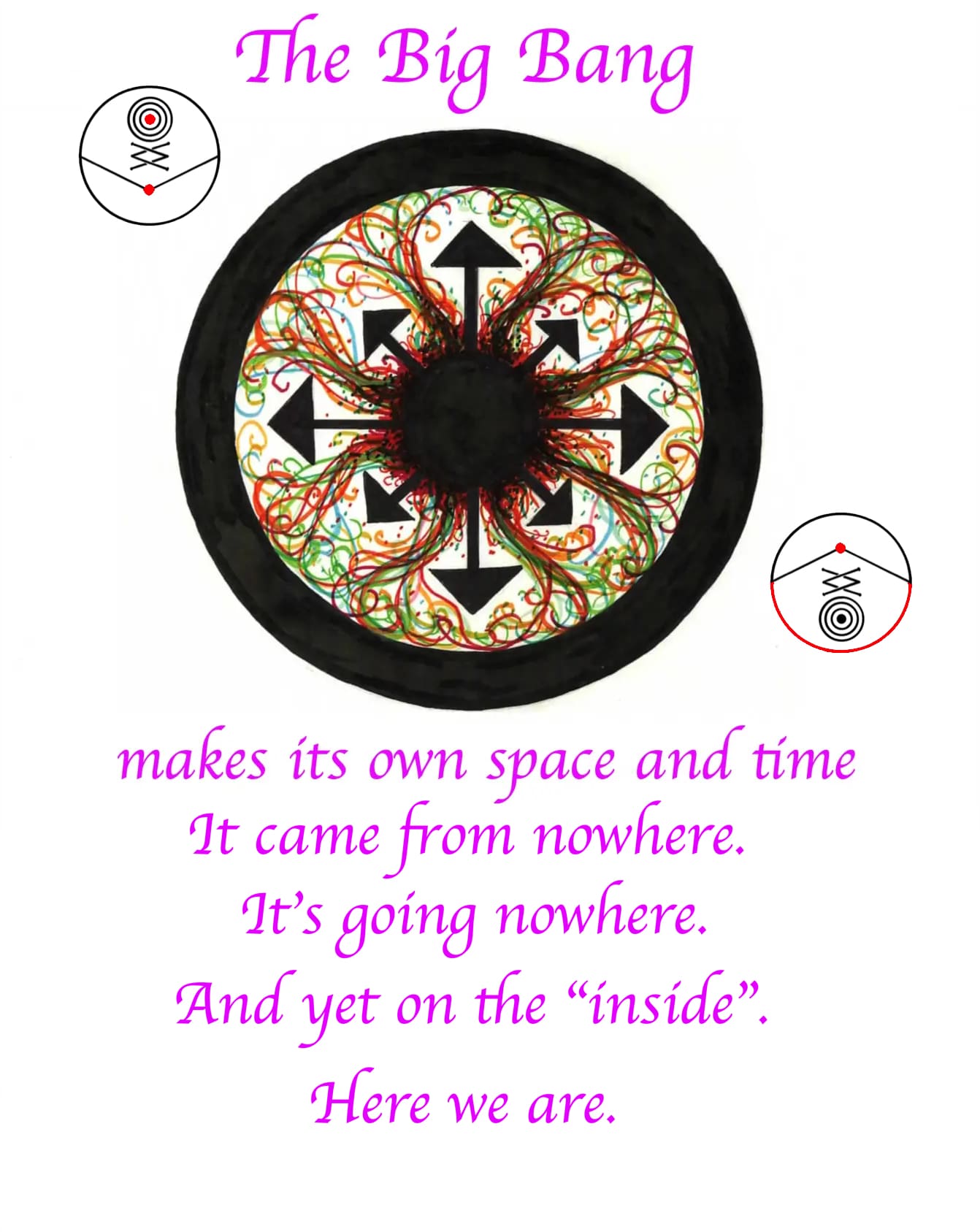
The Sun is the natural symbol for The Big Bang
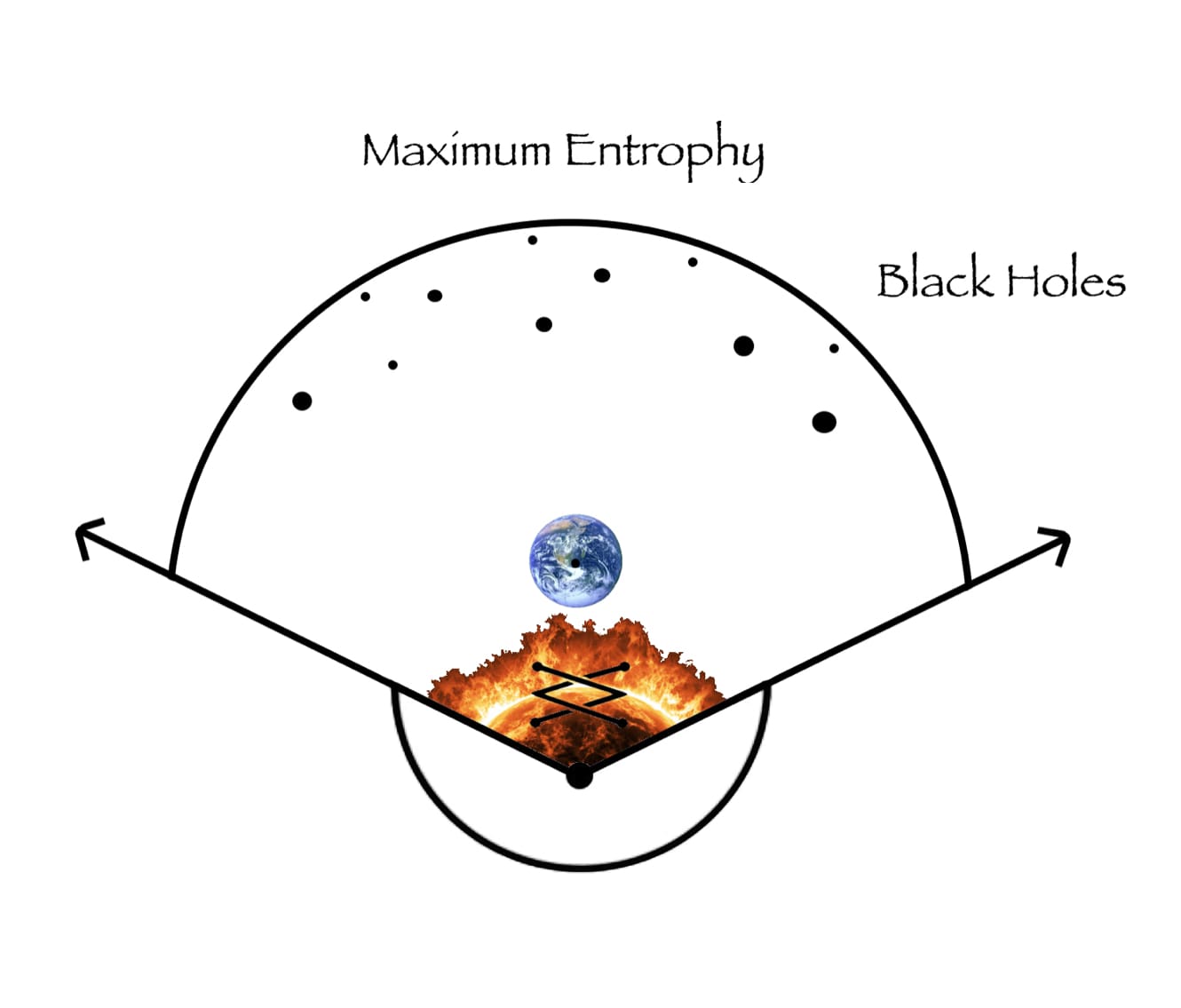
The Big Bang is now. It has no edge. And the center is everywhere.
essay soon
THE BIG BANG & SYMMETRY
We all long for the ultimate. And if the Big Bang, and all that follows, isn’t the ultimate, then it’s hard to imagine what is. But how can we interpret the Big Bang in a way that’s meaningful to our lives. One answer comes with the idea of symmetry. The Big Bang began as a single point of super symmetry. Symmetry means sameness, and everything was the same as it could be. For example, everything was in the same place, and everything was made of the same stuff. This is super-symmetry.
But then the symmetry broke, and everything was different. Time was different from space. Matter was different from energy. Matter was different from force, and the four forces were all different from each other. There were different galaxies with different stars. There were different planets, and different moons, and different forms of life. And now everybody is different from everybody else.
And yet some symmetry still remains. Matter has symmetry because generally ‘matter can neither be created nor destroyed’. And there are the conservation laws; the conservation of electric charge, the conservation of momentum, and the conservation of energy, to name a few. We are also heirs to various symmetries of space. ‘Sadly’, the total sameness of the beginning is gone. And yet, shattered remnants of that cosmic sameness still remain.
Life and the reproduction of DNA are an expression of symmetry. Indeed, ‘like begets like’ is the essence of life. Species emerge and remain stable over eons of time. Symmetry also plays an important role in culture. It means repeatability and elegance in science, math, and engineering. And symmetry also expresses itself in the common beliefs and goals of religion. We like what’s like us. So from this perspective, all religions are a fragment of the primal symmetry that gave birth to us all. And so, if we worship the Big Bang, we see a bit of divine symmetry in every like-minded group.
The symmetries of creation also offer other avenues for worship. For instance, the symmetrical unity of meditation could be connected to the quiet, but all pervasive 2.7 degree cosmic background radiation. Here we have a delightful metaphor for the omnipresent unity of God.
But symmetry is only half the answer. Instinctively, we know that too much symmetry is harmful. It must be mixed with a good dose of chaos, if life is going to change and adapt. That this universe can produce both symmetry and chaos is just one of an amazing array of coincidences that makes it right for life. But asking why this universe should be so hospitable to life brings us to the ultimate question. How did such a nice universe get here in the first place?